


BE A LIGHTHOUSE
For cities
Our media and street furniture can do more than just advertise. Join us in becoming an integral part of the cityscape and promote information, dialogue and culture in your city.

Innovative street furniture & smart services
Function with design and service: Our aim is to integrate street furniture and media stylishly and discreetly into the urban environment while helping to design modern public spaces by providing services and infrastructure. This includes the construction and management of customary street furniture such as bus shelters and toilet facilities, but also the provision of digital media and the option of displaying municipal information on them. Our portfolio also includes installations individually tailored to a city’s needs as well as the removal of unauthorised posters.
Sustainability is important to us throughout our entire product and service portfolio. Our digital advertising media are increasingly also being powered by electricity from renewable energy sources. Our operational processes are likewise subject to continuous optimisation in order to conserve resources and reduce CO2 emissions.
Smart City & Digitalisation
Thanks to the Internet, quick information and direct dialogue have become an ordinary part of our everyday lives. Digitalisation in the public space offers many interesting possibilities in this context.
Used as municipal information systems, digital media in public spaces facilitate the flow of information and dialogue between the city and its residents. Calls for citizen participation, event announcements to promote the cultural scene and support for local businesses contribute to a modern, open and solidarity-based community just as much as the possibility for ad-hoc warnings, real-time alerts about missing or wanted persons, and general safety notices. Placed along streets, in public transit areas, pedestrian zones, railway stations and shopping centres, a city can use the digital media in its “municipal information system” to reach its citizens in public spaces at any time.
Our “Kommunales Informationssystem für Städte “(KIS) [Municipal Information System for Cities] provides information for cities right on site. The content shown on our digital media is a varied mix, comprising editorial programmes such as news from our partner t-online or sustainability updates as well as infotainment in the form of weather reports or knowledge questions. Advertising is also included, primarily from local retailers.
Digital city information displays as a parking guidance system
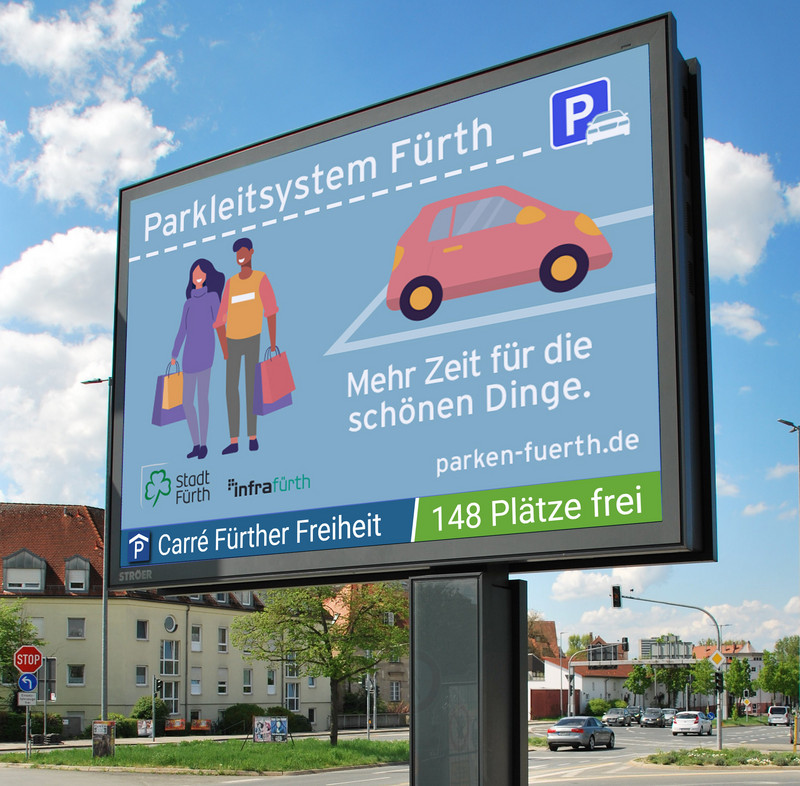
Since 2025, digital city information displays in Fürth have been showing drivers how many spaces are still available in the city centre’s multi-storey car parks. The six digital installations, featuring a total of eight screens, continuously display the number of available spaces across all eight car parks in Fürth in a ticker bar along the bottom of the screen.
News, warnings and socially relevant content have long been an integral part of our digital information screens. Real-time information on available parking spaces is the next innovative step towards smart urban communication.
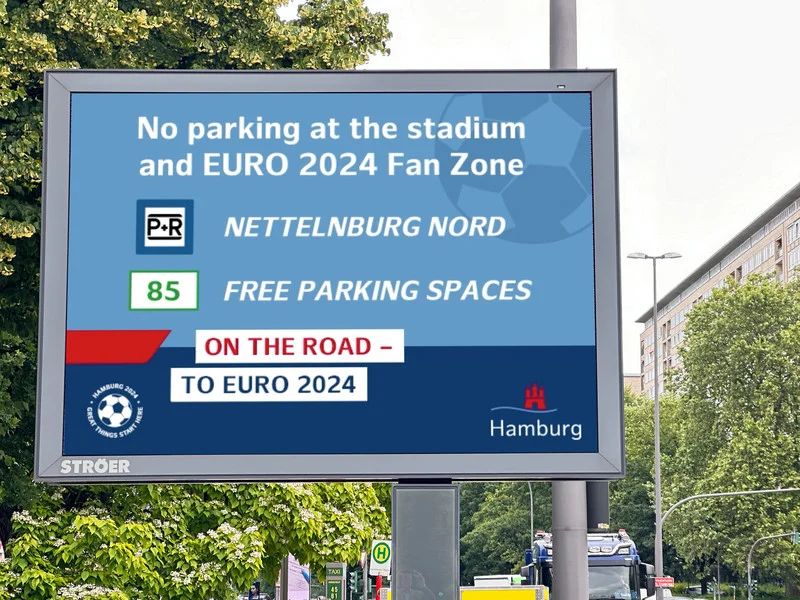
Ströer first made its digital communications infrastructure available for parking guidance in Hamburg in 2024. Working together with the Free and Hanseatic City of Hamburg’s Ministry of Transport and Mobility Transition, the system was introduced as a pilot project for UEFA EURO 2024 to help prevent congestion around the stadium and the fan zones in the city centre.
Unlike the screens in Fürth, the displays in Hamburg show full-screen parking information. These messages are integrated into the content loops and displayed repeatedly at regular intervals (see the image in the previous section). Following the UEFA EURO pilot project, Hamburg’s parking guidance system has also been used at other major events, including the Hamburg Port Anniversary. A version designed as a cycle guidance system has also already proved successful in the northern German city.
Digital warnings on Ströer screens
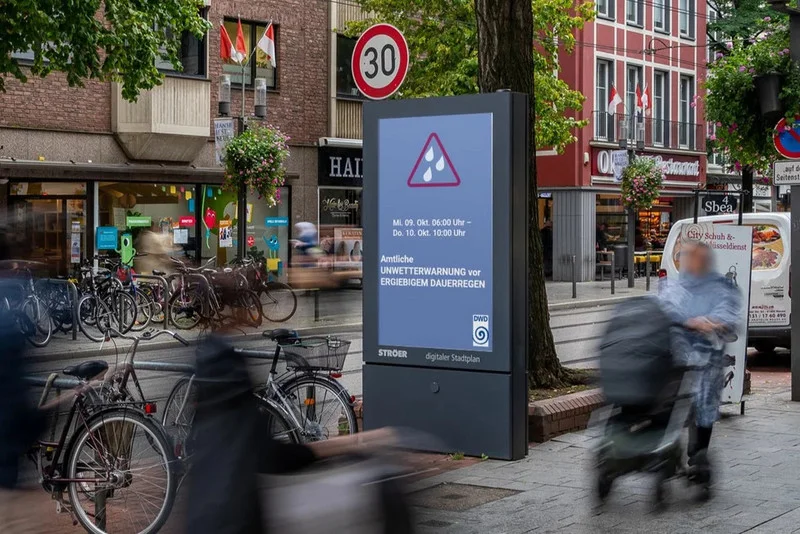
As part of a cooperation with the Deutscher Wetterdienst (German Weather Service / DWD), Ströer displays official extreme weather warnings from the DWD on more than 11,300 digital city information systems in over 400 German cities. The multifunctional outdoor media provide important information in real time about impending severe weather events such as gale-force winds or extreme heat. The aim is to warn the population in good time. The targeted regional dissemination of warnings can also provide maximum support to local crisis teams in minimizing potential damage.
In addition to the agreement with the German Weather Service, Ströer has been an official warning multiplier of the Federal Office of Civil Protection and Disaster Assistance since 2018 and is therefore able to issue official warnings and all-clear messages via the modular warning system (MoWas).


Smart solutions
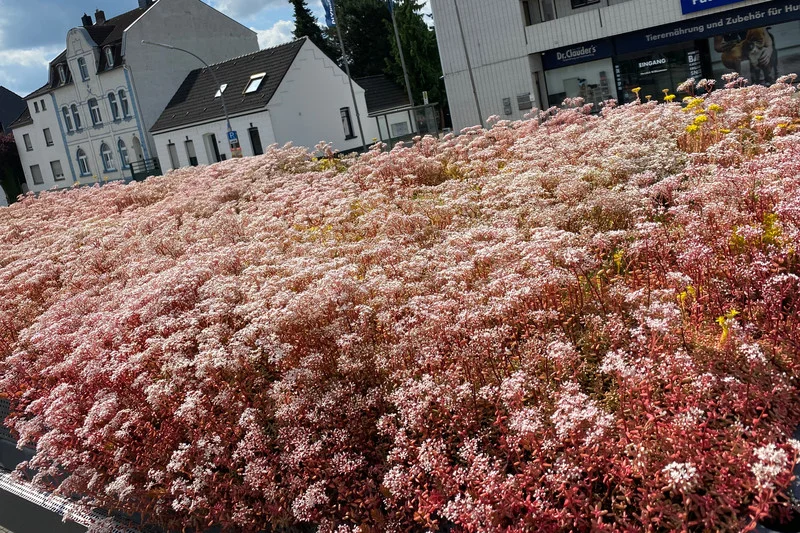
Together with external partners, we are developing sustainable space-saving solutions that can be integrated into or onto our advertising media and street furniture. These include air filters, energy-saving e-ink timetable displays, solar panels, sensor technology to measure air quality, and the greening of roofs and surfaces.
The result is street furniture and outdoor advertising media that make an active contribution to the continued development of the smart city model – communicative and digital.



Enhancing public safety through out-of-home media
Today, digital out-of-home media are far more than just platforms for commercial messages. They serve as information channels, amplify public warnings and are increasingly becoming part of urban safety infrastructure. With new additional features, Ströer is systematically enhancing its out-of-home media to strengthen resilience, provide faster assistance in emergencies and improve communication with the public.
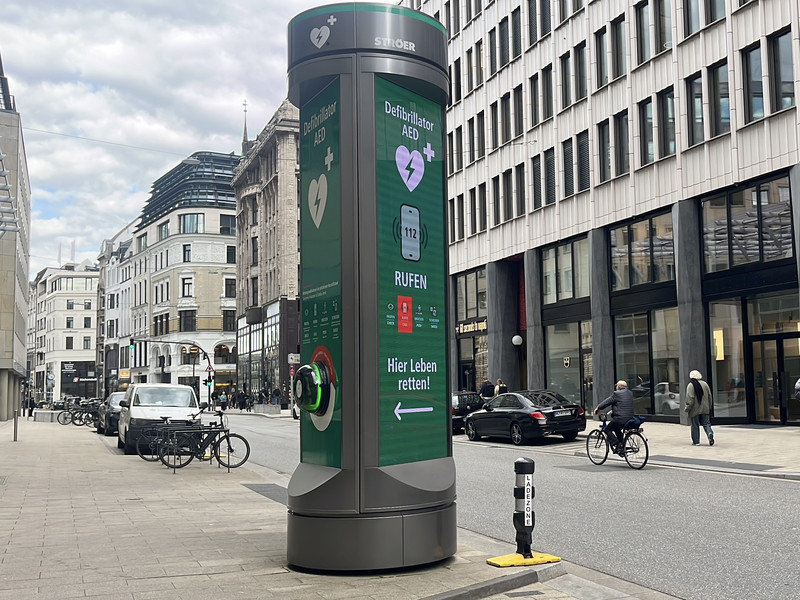
The defibrillator station in Hamburg: Help when every minute counts
Since 2025, Hamburg’s defibrillator station has demonstrated how public infrastructure can directly help save lives. In collaboration with Herzretter e.V. and the Free and Hanseatic City of Hamburg, Ströer has integrated a publicly accessible defibrillator into a digital media display for the first time. Located on Großer Burstah in the heart of Hamburg city centre, the station is positioned in an area passed by large numbers of people every day.
The AED (automated external defibrillator) is available around the clock and can also be used by people without medical training. Once removed from its housing, the device guides the person providing assistance through each step using spoken instructions. The most important information on how to use the AED is also displayed on the station itself, together with a QR code linking to further guidance.
Digital media displays and city information systems are particularly well suited to incorporating additional features of this kind. They already have the necessary power and data connections, are highly visible and are generally located in prominent, central locations.
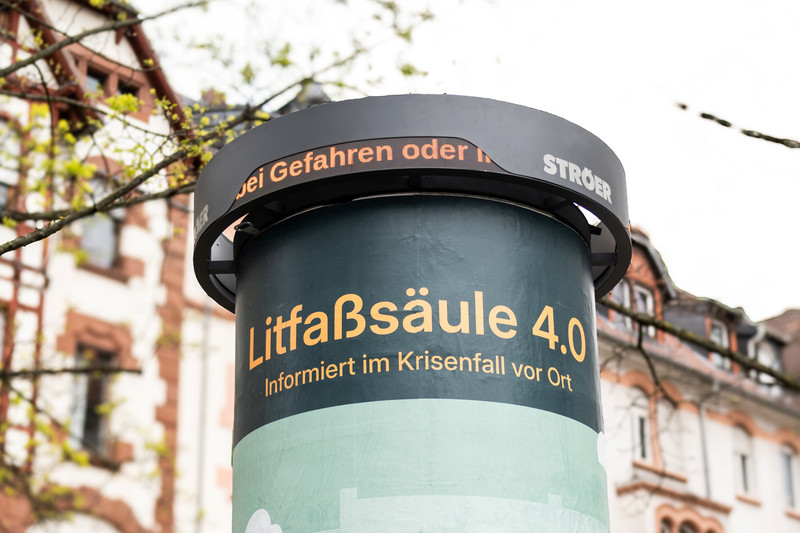
The advertising column 4.0: Crisis communication during power outages
Another example of how traditional out-of-home media are being transformed is the Advertising Column 4.0. As part of a joint research project with the LOEWE Centre emergenCITY at the Technical University of Darmstadt, Ströer has developed a modern version of the traditional advertising column. Its purpose is to continue providing the public with important information even when electricity, mobile networks, internet services or television are unavailable.
The Advertising Column 4.0 combines LED displays with photovoltaic technology and a methanol fuel cell, enabling it to operate independently for up to 72 hours. In a crisis, warnings and recommended actions from the Modular Warning System (MoWaS) can be displayed directly in public spaces. Fire and emergency services and public authorities have access to the system and can communicate information to specific locations as required.
The project thus builds on the original purpose of the traditional advertising column: to provide people in public spaces with reliable access to important information – now in a digital format designed to remain operational during power outages.
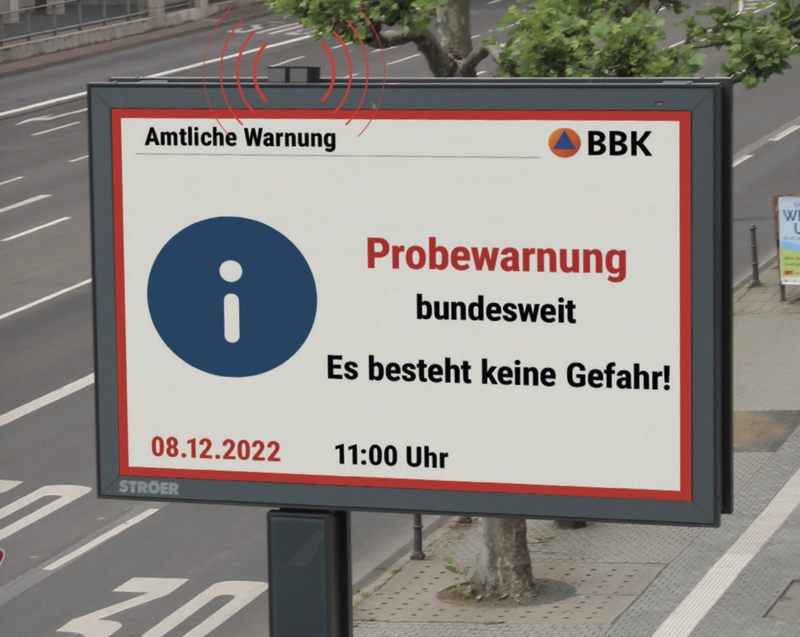
Sirens on out-of-home media: Making warnings seen and heard
In addition to displaying visual warnings on digital city information screens, Ströer is also developing acoustic solutions for public safety and emergency communication. The first high-performance loudspeakers designed for direct installation on out-of-home media were developed as early as 2022. They complement existing rooftop sirens and enable targeted, localised warnings to be issued to the public.
The systems are controlled by the fire services and can broadcast both warning signals and spoken announcements. With a range of around 400 metres, they are particularly well suited to densely built-up city-centre areas. A key advantage is that digital warnings on screens and audible warning signals work together, helping to reach people with visual or hearing impairments more effectively. Initial trials conducted with fire services have already been completed successfully.
How it works – Roof greening in fast motion


